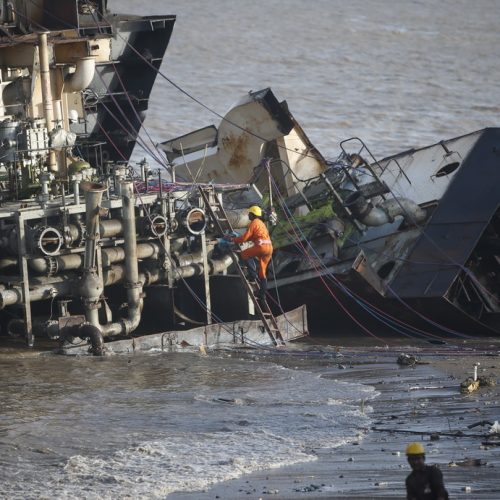
Press Release – MSC urged to align its operations with international environmental and labour rights standards and stop dumping its toxic waste on South Asian beaches
One of the world's largest container shipping companies, Mediterranean Shipping Company (MSC), is again under the spotlight for its substandard and hazardous dismantling of obsolete vessels on tidal beaches in South Asia. While the company has repeatedly faced criticism for breaching international environmental and labour rights standards, it has so far not shown any willingness to improve its practices.
Claiming to be committed to sustainable operations, MSC has received several awards including the Greenest Ship Owner of the Year at the 2018 Green Shipping Summit in Amsterdam. Yet, the Swiss shipping giant has over the last fifteen years sold more than 100 end-of-life vessels for dirty and dangerous scrapping on South Asian beaches. In the last six months only, MSC scrapped 9 ships on the beach of Alang in India - 27 in the last two years, including the MSC FLORIANA and MSC GIOVANNA. These vessels left respectively from Spanish and Turkish waters in direct violation of European and international laws prohibiting the export of hazardous waste from OECD to non-OECD countries.
MSC's poor management of its end-of-life assets is particularly deplorable given its financial strength. The company, with a staggering $86 billion turnover in 2022, is expanding rapidly, with an estimated capacity soon matching the combined fleets of competitors Maersk and Hapag-Lloyd. However, despite the financial capacity to sustainably recycle their end-of-life fleet, MSC seemingly prefers to accumulate profits by exposing workers, vulnerable coastal communities and sensitive ecosystems to harm. Indeed, with prices reaching up to $500 per Light Displacement Tonnage (LDT) for scrapping on the beaches of South Asia, MSC can earn up to three times more compared to recycling its assets in EU-approved facilities.
By contrast, earlier this year, MSC UK launched the Waste Shipment Intelligence Service in collaboration with the UK Environmental Agency, aiming to curb the illegal trade of waste on-board its vessels. In August this year, MSC also returned 40 containers of hazardous waste that had been illegally exported on-board two A.P. Moller-Maersk’s A/S - another company that dumps its end-of-life vessels on South Asian beaches - chartered ships from Albania.
Currently, MSC’s recycling policy remains weak, relying solely on the Hong Kong Convention (HKC), a framework widely criticised for failing to ban beaching and properly manage hazardous waste downstream. Also, while the company claims to audit scrapping yards, it provides no transparency on the process or results. Independent audits have already found major flaws in yards that claim HKC compliance, particularly in South Asia, and that are used by MSC.
MSC's top management also came under scrutiny from Swiss media for its aggressive lobbying efforts directed at the Swiss Federal Tax Administration (FTA). The aim was to introduce an exceptionally favourable tonnage tax regime in Switzerland, which could have resulted in virtually zero taxation for the company. According to detailed reports from Reflekt, MSC succeeded in incorporating several items from its "wish list” into the draft bill of the Swiss tonnage tax regime, including the removal of stringent requirements related to flag states and labour rights compliance. However, the National Council rejected the draft proposal in May 2024.
Repeated attempts by the Platform to engage with MSC’s sustainability team on their recycling policy have gone unanswered. As MSC continues to turn a blind eye to the irreversible damage caused by the poor end-of-life management of its fleet, and lobbies for lowering compliance with international labour rights, there is growing global emphasis on both environmental sustainability and corporate accountability. Companies are expected to align their operations with not only their stated values, but also the law. The Platform remains committed to assisting companies achieve this, including by means of actively supporting technological innovation and meaningful advancements in the ship recycling sector to create capacity for sustainable ship recycling.
MSC’s competitor CMA-CGM is already exploring how to boost sustainable ship recycling in Europe following a commitment in 2022 to not transport plastic waste on-board its vessels. Now is the time for MSC to show whether or not they are truly committed to sustainability throughout their entire operational chain.
NOTE
(1) Several high-profile legal proceedings, such as those surrounding the Harrier case, are drawing attention to persistent violations of EU laws by ship owners attempting to circumvent regulations. Criminal investigations underway in multiple EU nations, including Germany, reflect a growing international commitment to holding offenders accountable and strengthening regulatory enforcement to address environmental and labor hazards associated with unlawful shipbreaking.
Related news
Platform News – Norway’s largest Pension Fund highlights human rights and environmental risks related to shipbreaking in South Asia
KLP, Norway’s largest pension fund [1], commissioned the International Law and Policy Institute (ILPI) [2] to write a report on the human rights and environmental risks related… Read More
Press Release – Worst corporate dumpers asked to clean up their acts
Targeting sustainability and fleet managers, the NGO Shipbreaking Platform calls for the adoption of responsible ship recycling policies in letters sent to shipping companies standing out for… Read More
Platform publishes South Asia Quarterly Update #32
Eight workers suffered an accident on South Asian beaches in the last quarter of 2022.
... Read More
Platform publishes South Asia Quarterly Update #23
There were a total of 170 ships broken in the third quarter of 2020. Of these, 110 ships were sold to the beaches of South Asia.
... Read More
Platform publishes South Asia Quarterly Update #19
There were a total of 193 ships broken in the second quarter of 2019. Of these, 146 ships were sold to the infamous scrapping beaches of South… Read More
Press Release – Platform publishes list of ships dismantled worldwide in 2018
744 large ocean-going commercial vessels were sold to the scrap yards in 2018. Of these vessels, 518 were broken down on tidal mudflats in South Asia.
... Read More