
EU SHIP RECYCLING REGULATION
The European Parliament and the Council of the European Union adopted the Ship Recycling Regulation (EU SRR) on 20 November 2013. The objective of the Regulation is to reduce the negative impacts linked to the recycling of ships.
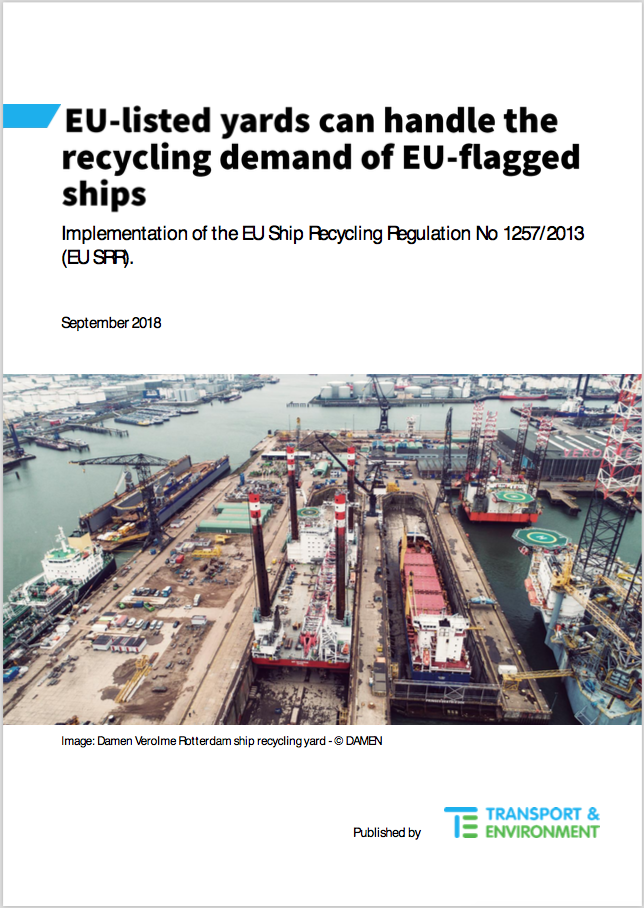
From 31 December 2018, EU-flagged commercial vessels above 500 GT must be recycled in safe and environmentally sound ship recycling facilities that are included on the European List of approved ship recycling facilities. The List was first established on 19 December 2016 and is periodically updated to add additional compliant facilities, or, alternatively, to remove facilities which have ceased to comply. Currently, the List comprises facilities operating in the EU, Turkey and US.
To be included in the European List, any ship recycling facility irrespective of its location has to comply with a number of safety and environmental requirements. Facilities operating in the EU are approved by their national authorities for listing. The European Commission assesses applications received from the ship recycling facilities located in third countries. The EU List functions as an important market differentiator for yards that have already invested in proper occupational safety and environmental standards.
Whilst the Regulation brings forward the requirements of the 2009 Hong Kong Convention for the Safe and Environmentally Sound Recycling of Ships, it also includes additional safety and environmental requirements. Indeed, the EU SRR sets higher standards than the IMO’s Hong Kong Convention – the beaching method is not allowed and requirements related to downstream toxic waste management as well as labour rights are included. Moreover, EUlisted ship recycling facilities are subject to a higher level of scrutiny: there is independent third party certification and auditing, and NGOs, such as ours, are allowed to submit complaints should they have concerns that a listed facility is not operating in line with the Regulation. These are important safeguards that are alarmingly absent under the Hong Kong Convention regime. EU-listing is indeed the only guarantee that a yard has been independently certified and audited up against an acceptable standard.
To ensure legal clarity and avoid administrative burden, ships covered by the new legislation will be excluded from the scope of the Waste Shipment Regulation. Non-EU flagged vessels sold for scrapping whilst in European waters will remain covered by the Waste Shipment Regulation.
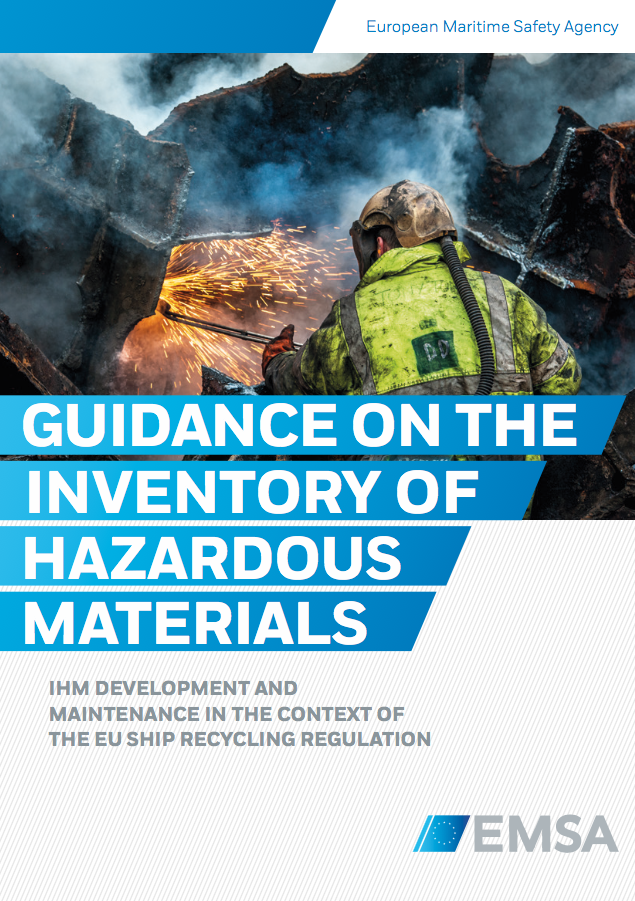
European ships, as well as vessels sailing under the flag of a third country and calling at an EU port or anchorage, will furthermore be required to have on board an Inventory of Hazardous Materials (IHM).
THE SHORTCOMINGS
The shipping industry is difficult to regulate due to the use of flags of convenience. The majority of European shipping companies do not register their ships under the flag of an EU Member State during their operational life, and opt instead for flags of convenience such as Panama, Liberia, the Marshall Islands and Bahamas. Port states have thus increasingly been seen as solution providers to fight the many substandard practices of shipping.
A major shortcoming of the Ship Recycling Regulation is that ship owners can circumvent the law by simply swapping their EU flag to a nonEU flag. Major European ship owner Maersk has already threatened to flag-out from the Danish ship registry to allow the use of non-EU approved shipbreaking facilities on the beach in India. This move has been strongly criticised by environmental NGOs and clearly illustrates why measures that go beyond flag state jurisdiction are needed to hold the shipping industry accountable for environmental and social protection.
INTRODUCING A FINANCIAL INCENTIVE: A POSSIBLE SOLUTION
EU ship owners account today for about one third of the endoflife tonnage beached in substandard yards in Bangladesh, India and Pakistan. Thus, as the single largest market selling endoflife ships for dirty and dangerous shipbreaking the EU has a particular responsibility to regulate ship recycling. Proper implementation of the Ship Recycling Regulation entails making sure that ship owners are directed towards the use of EU-approved recycling facilities and do not simply flag out to circumvent the law.
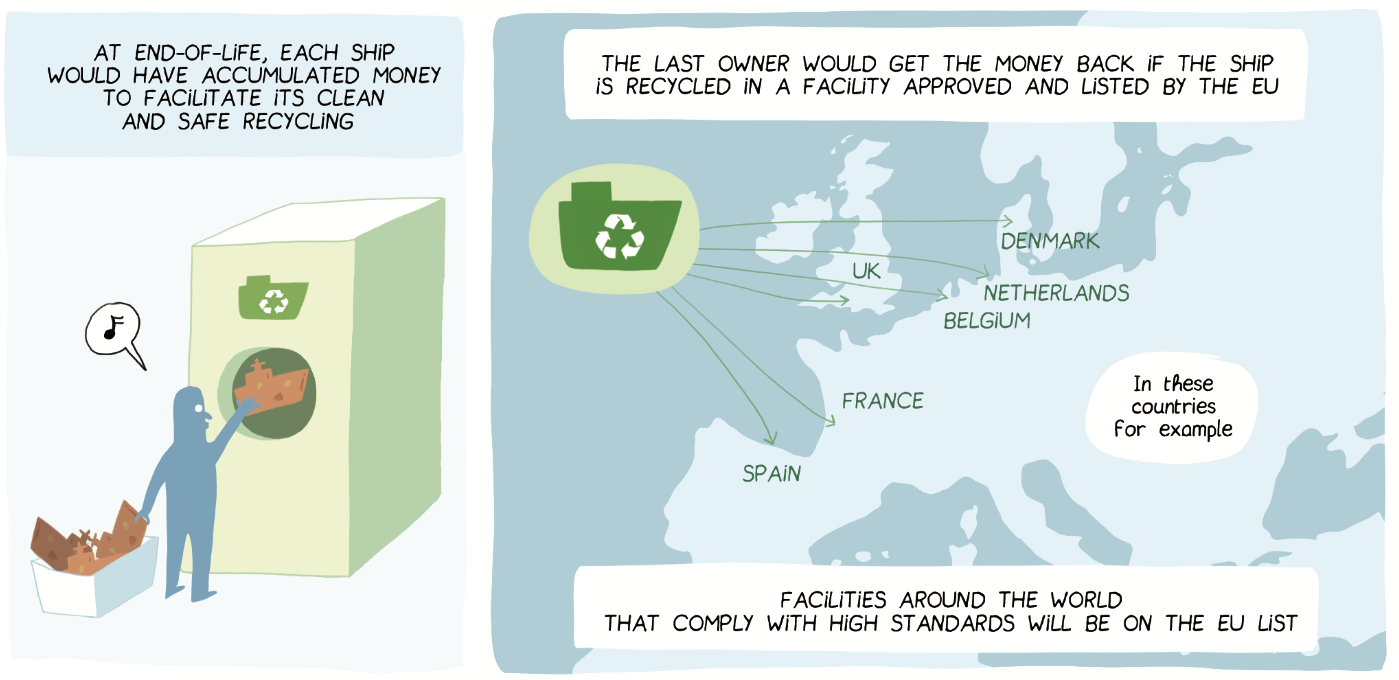
A report written jointly by Ecorys, the classification society DNVGL and Erasmus University School of Law, and published by the European Commission in July 2016, looks into the possibility of introducing a financial incentive to enhance safe and environmentally sound ship recycling. The report recommends that contributions for a ship recycling licence are collected from all ships visiting EU ports, regardless of their flag. The capital amount accumulated during the operational life of the vessel would be set aside for the ship and be earmarked to reduce the cost gap between substandard and sustainable end-of-life ship management. This amount would only be paid back to the last owner of the vessel if the ship is recycled in a facility approved by the EU.
RECOMMENDED READINGS
Latest News
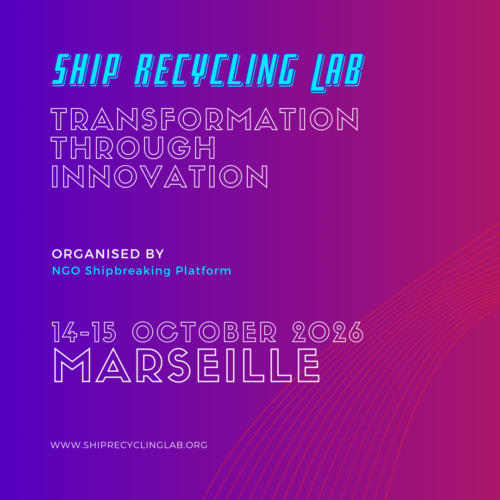
Save The Date – Ship Recycling Lab 2026: Transformation Through Innovation
After the successful organisation of two editions of the Ship Recycling Lab: Transformation Through Innovation back in 2022 and 2024, the NGO Shipbreaking Platform, still recognising the need… Read More

Press Release – Environmental NGOs urge action after European Commission study exposes abuse of vessel flagging rules
As the European Union positions itself as a global leader on ocean governance during the EU Ocean Days in Brussels and publishes its new Maritime Industrial Strategy,… Read More

Press Release – Turkish civil society organisations reiterate their call to remove Aliağa shipbreaking yards from the EU list amid environmental damage and systemic negligence
Members of Turkish organisations raise alarm about critical levels of pollution in Aliağa, as well as severe systemic mismanagement, and continue their call to remove Turkish shipbreaking yards from the EU list of ship recycling facilities until necessary improvements are introduced by the Turkish authorities and the yards.
... Read More